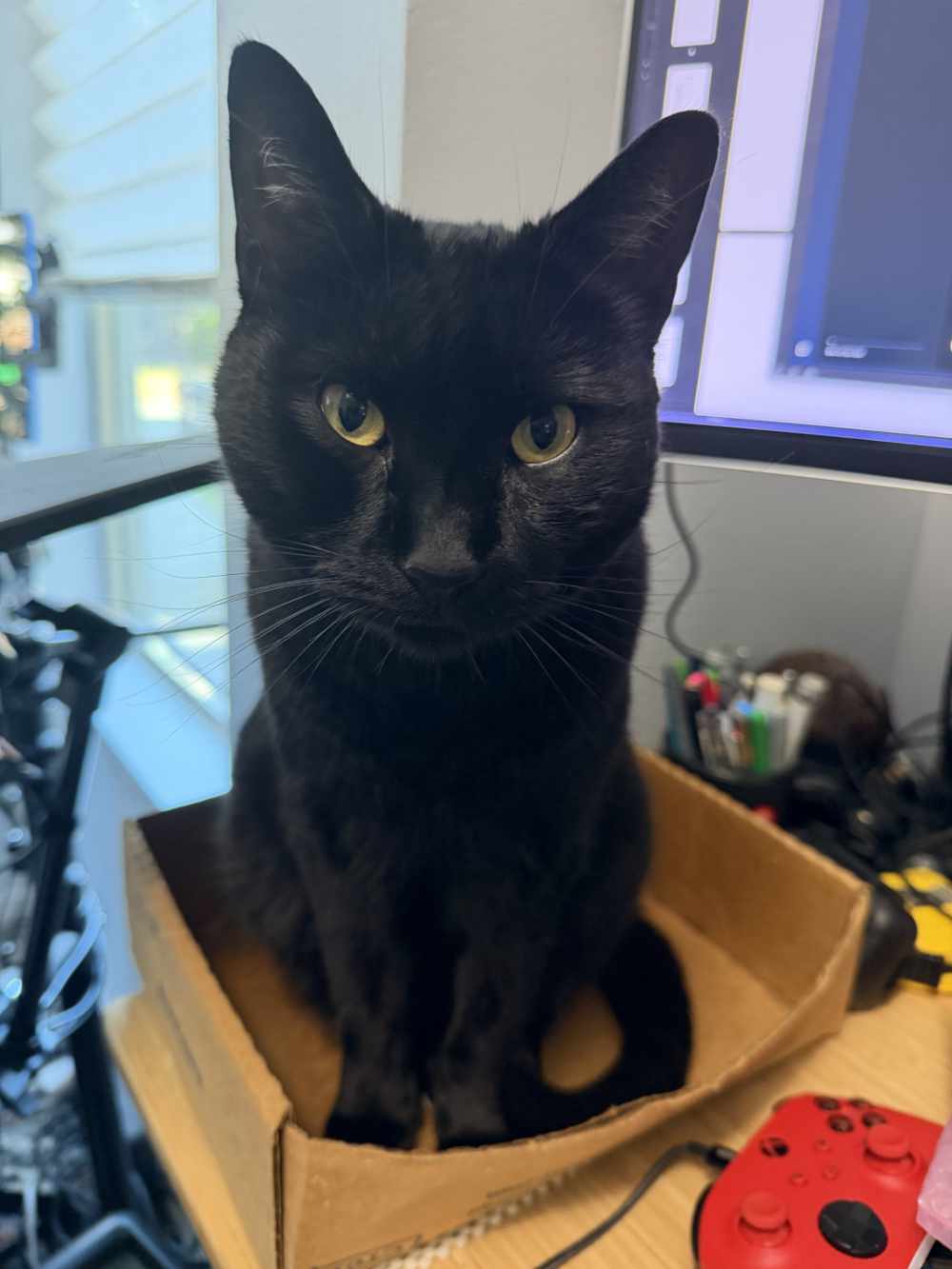
The future is ours to design, make it a good
Fri, 23 Oct 2026
If you're in the US like me, you might also be just exhausted by... everything. Yes it's election season and that certainly is part of it, but it also just feels like the mask has slipped on every major business player and they're all just running at maximum "immiserate the people to make the quarterly numbers go up." That takes the form of even more layoffs and even more being asked to "do more with less" for the people who are lucky enough to survive the now seemingly endless waves of layoffs. Also whatever this shit is. (Seriously, the selling point for Copilot is officially "steal your coworkers ideas because you're jealous of them and not good enough at your job to be recognized otherwise" I guess?)
All the while the "design leaders" are pushing basically the same stuff they have been for years, just with "AI" now. And I'll be honest with you, I've had a really hard time not being erupting-volcano-mad about every warmed over "Are you focusing too much on craft and not enough on the real value of design?" post I've had the misfortune of seeing this week (they all have something like "in the Era of Agentic Intelligence" tacked on to them, which...just... 🙄) And it makes me even more mad that most of them obviously just had their slop subscription churn out 5 paragraphs that said the same nothing thing they've been saying for a decade to provoke a response that I have now given them. And I know I'm not alone. If you're reading this you probably feel this way too about * waves hands frantically all around. * But you're also here because this is a newsletter about learning about design and how to be a better designer and what is the point of all of this, Tony? This is a fair question, fake person in my head that I use as a writing crutch to move the story along when I can't think of a better transition.
In the spirit of transparency, I've written this newsletter four times this week, because I really couldn't figure out what the point of me telling you about all of these feelings was, but I knew was it relevant. I don't want this to just be a rant, there has to be something useful in these feelings, right? Big thank you to Erika Hall for publishing this week's Mule Design newsletter when she did, because it very much helped me find the word I was circling around but couldn't land on: Fatalism.
I was very fortunate to give a talk last week at the University of Colorado Boulder's ATLAS Institute colloquium. That talk was about Design Lessons and the larger goals of the Not Just Pretty Pictures project and why it's something we decided to do as part of We Beasties. But it was also about making the future better than the present, both in big ways and also in the much smaller "we need a better place to do the work of design" way. I've seen a lot of designers expressing similar frustration about The State of Things(tm), and I truly believe that we can make a better path and find new, better places to do the work if we do the work to make those spaces. And to do the work you need to have the right skills and know how to use them. Boom! Full circle back to Design Lessons. (Sign up for your free goal setting lesson today!)
Doing the work is not easy. It becomes overwhelming at time to exist in a media ecosystem that relentlessly beats you over the head with fatalist messages. That's when I remembered my Doc Brown (yeah, I'm not as well read as Erika, you're mostly getting movie and TV references from me), "Your future hasn't been written yet. No one's has. Your future is whatever you make it, so make it a good one." That is the whole point of design, isn't it? To make the future. Then I remembered a slide I put up near the end of my talk (after talking about "Design for the Real World", hence the reference in this image.)
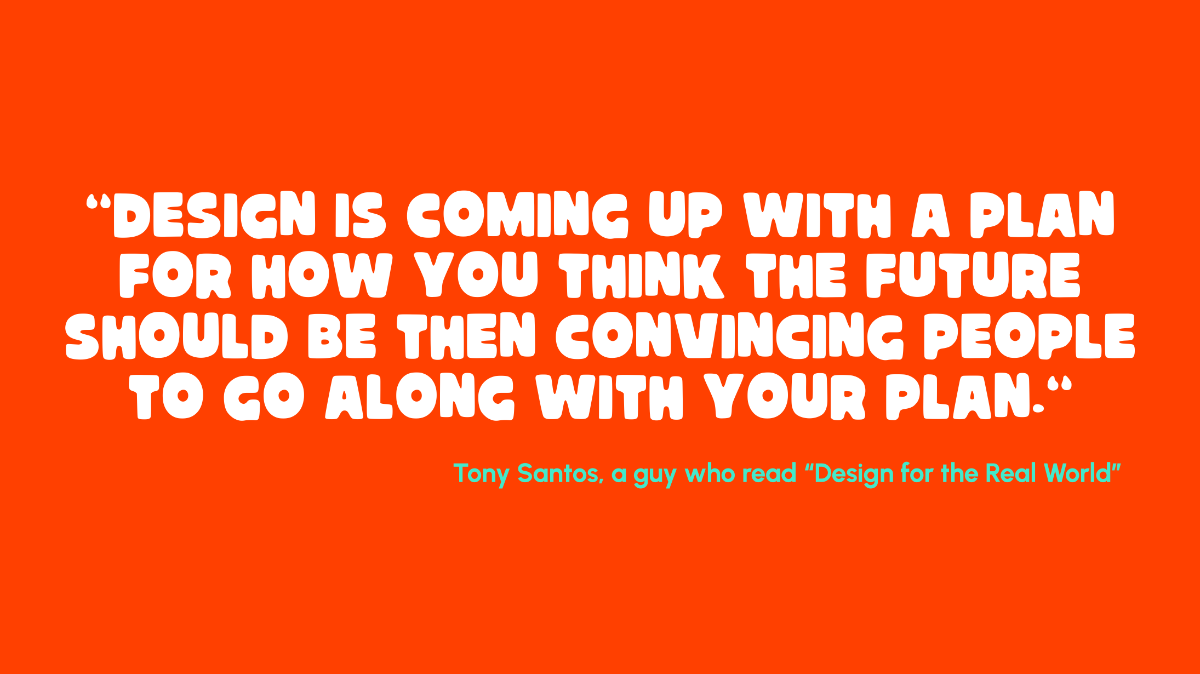
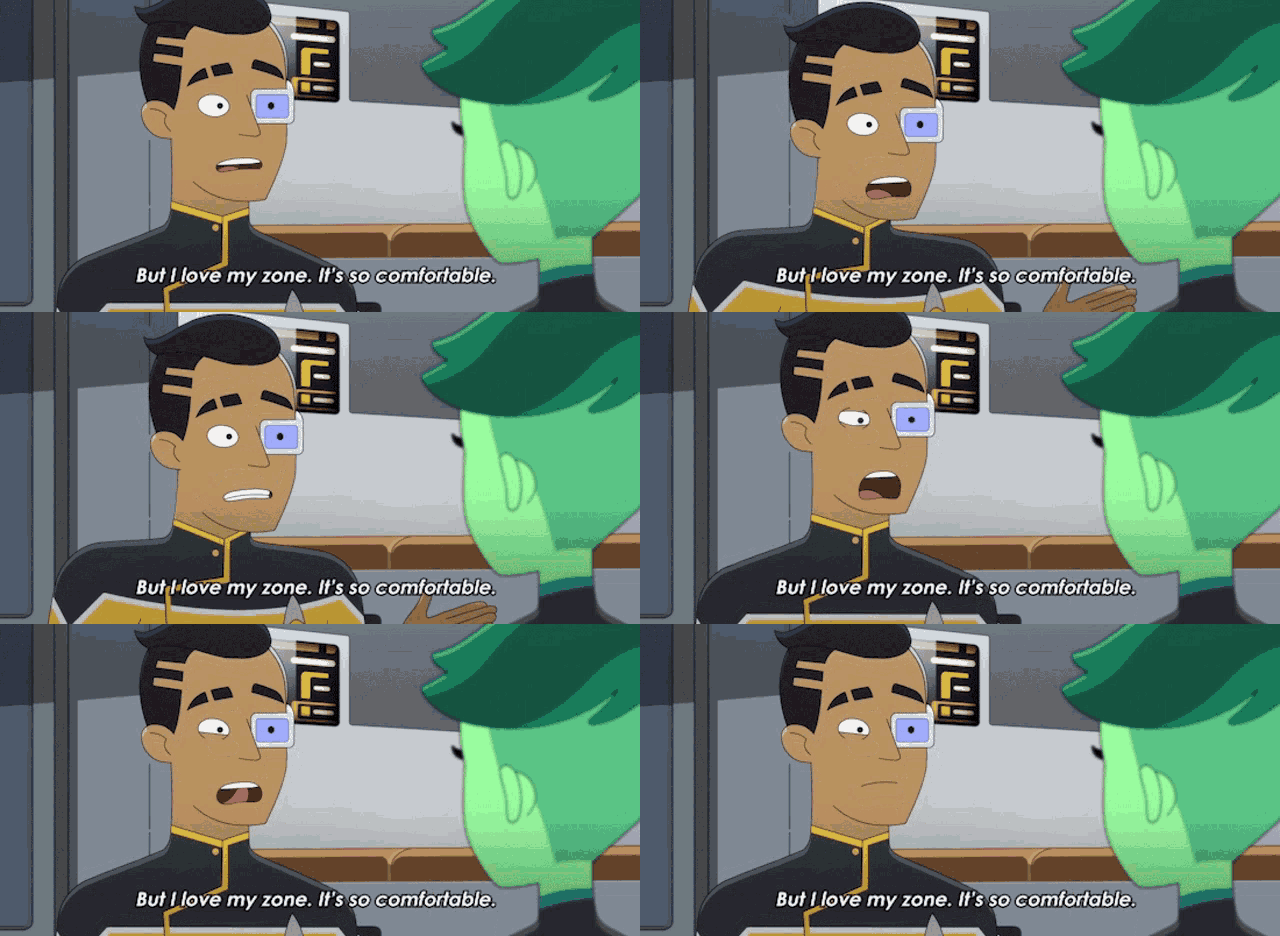
When I'm working with students (or just talking about the nuts and bolts of design) this is the definition I use because it is a useful set of two buckets that design skills can all be placed in: the skills you use to make the plan and the skills you use to convince people to do the plan. The first bucket is where a lot of specialization comes in, making a plan to communicate and change people's minds about something in the future requires different skills than making a plan for a new building to exist in the future. The second bucket applies pretty much no matter what you are planning and it's that second bucket that we forget about most of the time (myself very much included.) One of those skills, I'm starting to realize more and more these days, is being able to diffuse the fatalism we're all constantly being hit over the head with so we can imagine other futures are possible. That starts with remembering it yourself. You are very much on of those people that need to be convinced to go along with your plan. And I know, it's so much easier to just accept "this is the future, get on board or get left behind." It's simpler, it narrows the possibility space so drastically. Now all of your effort can fit into a nice, narrow, comfy zone. But you don't don't create new paths or better futures working in that zone.
"Don't let the bastards get you down" is a lot easier said than done sometimes. I'm starting to believe it's just another skill to be practiced, which is to say I'm starting to see the value in practicing it regularly myself. And you know what? Just even thinking about it that way has helped me feel better this week. Less angry, more hopeful (still tired. We all could use a break, right?). The future is whatever we design, whatever we plan and convince other people to help us make. So let's make it a good one. (yeah, I know, that ending is cliché but it's genuine.)
Enough talking, let's do design!
We too often ignore those "convince people to go along with our plan" skills, so lets get some reps in on those this week. A major part of convincing people of pretty much anything is to present it in a way that makes a strong emotional appeal to them. Yes, pretty much every human is making decisions based on feels (especially, in my experience, the ones who are the loudest about being "data driven.") So how do you do that? Sounds simple, right? When I say "emotional appeal" here I'm not talking about "tug on their heart string making them feel something" so much as I'm talking about "making your argument aligned to things they already believe, regardless of how true or relevant those things are." That will make more sense in a second, I promise.
Here's what you need
- Our bestie the timer (probably your phone)
- An old piece of work you did, doesn't matter what it is as long as you have finished it
- Something to write notes in (you got a sketch book like we talked about a few weeks back, right?)
Here's what you do
- Review that old work, give yourself five or so minutes to do this. If you finished it recently you might not need that much time, but just refamiliarize yourself with it. Think about all the stuff that happened while you were doing it.
- Write this question down and then answer it: Who were the stakeholders for this project? (The real stakeholders, the ones with the power to make it or break it. Who had the power to kill this work, those are the stakeholders.) Try not to spend any more than 1-2 minutes on this.
- Write this question down and then answer it: What do they care about the most? Try not to spend any more than 1-2 minutes on this.
- Write this question down and then answer it: What are their incentives? Try not to spend any more than 1-2 minutes on this.
- Set your timer for 10 minutes and then write a short explaination of the work you just reviewed, framing it in terms that align with what your stakeholders care about and their incentives (these are not always the same). Important: Make sure you're not talking about stuff you care about. Not stuff "the users" care about. Not just descriptions of what you did. Talk about why you did what you did.
Why do this? Very often we are used to explaining things in terms of what we did, which is honestly a terrible way to explain things to anyone with functioning eyeballs. The next level up is explaining things in terms of "The Users" and this is not a bad instinct, it's what Human-centered Design is all about. Except, we don't live in a world where "The Users" get a vote most of the time. If we did, things would be VERY different. We live in a world where people who have accumulated power get to decide, and so those are the people we need to convince (or we need to accumulate enough power ourselves to counter them, but that is a different newsletter.)
Recognizing who the people with power are, what they care about, and what they're incentivized to do is a skill. You have to practice it, first in conditions where you have time to think through things, if you want to ever hope to be able to do it on the fly (which is essentially what a pitch or a work review meeting is).
The real trick, if you are a human-centered designer like I am, is being able to use this skill to help you appeal to the people with power while not selling out the people who are impacted by your design. The real usefulness coming from seeing when what stakeholder's actually want is completely incompatible with your plans, because those are not people who you are going to convince to go along (see: the previous parenthetical about accumulating power. Unionize your workplace. )
The better you get at this, the more you will start to see how many of the places designers have found to do work in the last decade are no longer run by stakeholders who want or care about any of the futures we want to build. And that sucks, but you will also start to see some of the places designers have not spent much time where there are stakeholder who are incentivized and care about what we're trying to do, and that's how you get things done.
More from We Beasties
- Design Lessons! Learn how to make well-crafted plans for the future AND how to convince other people to go along with them. Using these skills is the only way we're going to make a better place to do the work. Sign up for a free goal-setting lesson
- In times like these your feelings can really be a lot. Silvia made some representations of them that are cute as hell (and one of them is our logo) Grab and anxiety animal, let it out
Your moment of Pancake